New poll results: Trust in the media stays low, but confidence in specific national outlets runs higher
June 10, 2026—Only two of eleven of the most well known national news organizations have a majority of Americans who have a great deal or fair amount of trust in them, according to a new survey conducted by YouGov for the Center for Integrity in News Reporting. However, the survey also found greater trust among these 11 national news organizations individually than estimates of public trust in the mass media in general.
The survey also highlights a reason for the lack of trust, as only 12% on average say they have 'a great deal of trust' that these news outlets present facts without intentionally omitting important information that could change the meaning or context. It also suggests a possible way to increase trust, with the public saying only 13% of these news organizations on average always make a clear distinction between news and opinion.
"For readers and viewers to trust news reporting, they need to understand what a news organization stands for. Adopting a concise statement of core journalistic values and making it transparent is a relatively inexpensive step that a number of news organizations have already taken and one that can help rebuild trust, transparency, and accountability," according to Rufus Friday, Executive Director of the Center for Integrity in News Reporting.
The survey, conducted by YouGov between February 16 - 26, 2026, finds that Americans are about evenly divided in their preference for reporting that takes a more neutral approach (reporting the statements of public officials and others and let the news consumer decide what they believe to be the truth- 53% of American say this) and a more active style of reporting that tells news consumers about what news organizations consider the accuracy or inaccuracy of statements directly (47%).
Share of Americans who say they prefer media that …
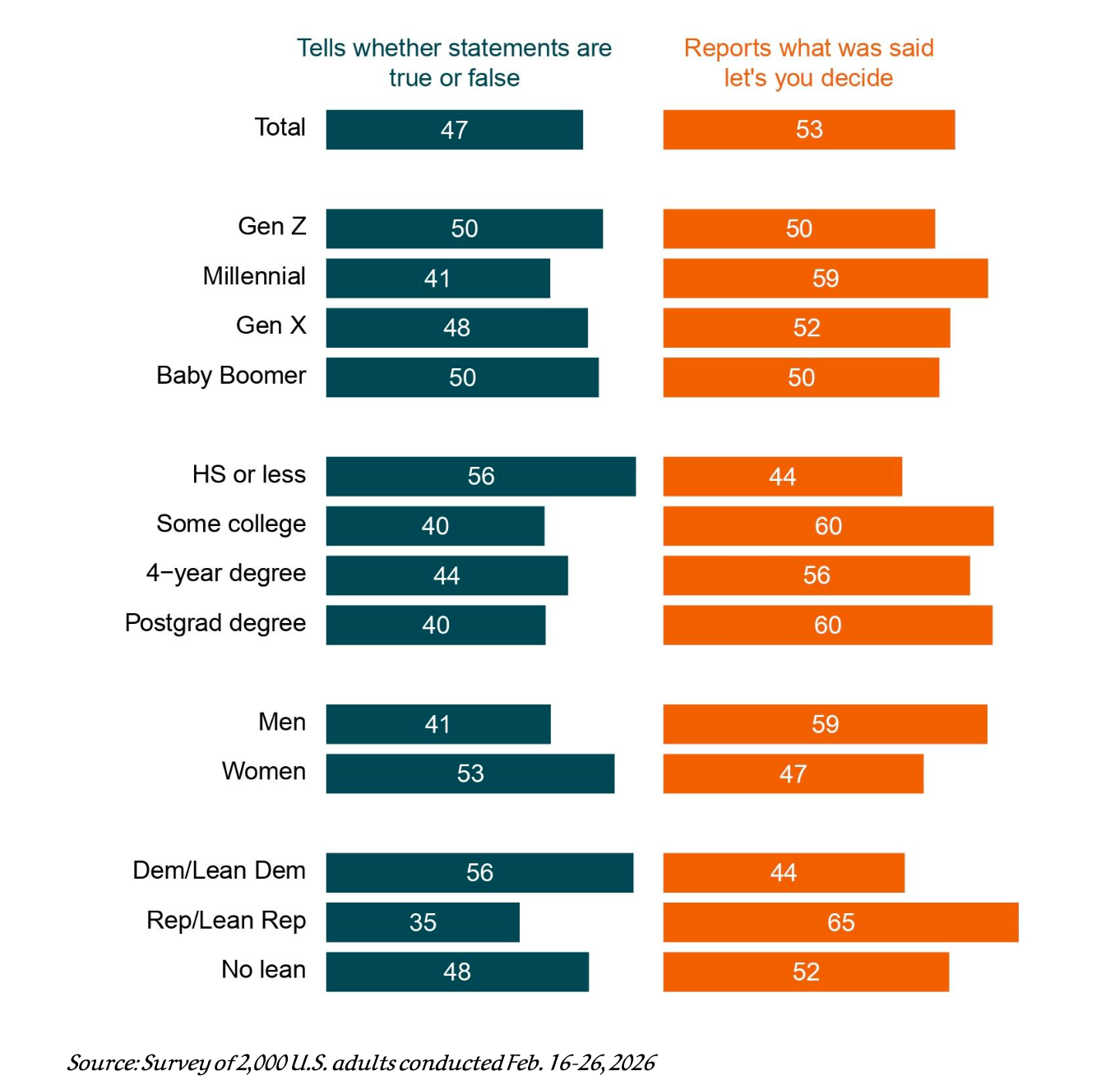
When presented with a choice between reporting that "that tells you whether someone's statements are true or false" or reporting that "tells you what someone said, and you determine if it's true or false," Americans are about evenly divided between the two. Men, those with higher education, and Republicans were somewhat more likely than others to say they prefer reporting that leaves it to the news consumer to determine whether the reporting is true or false.
Evaluations of major news outlets
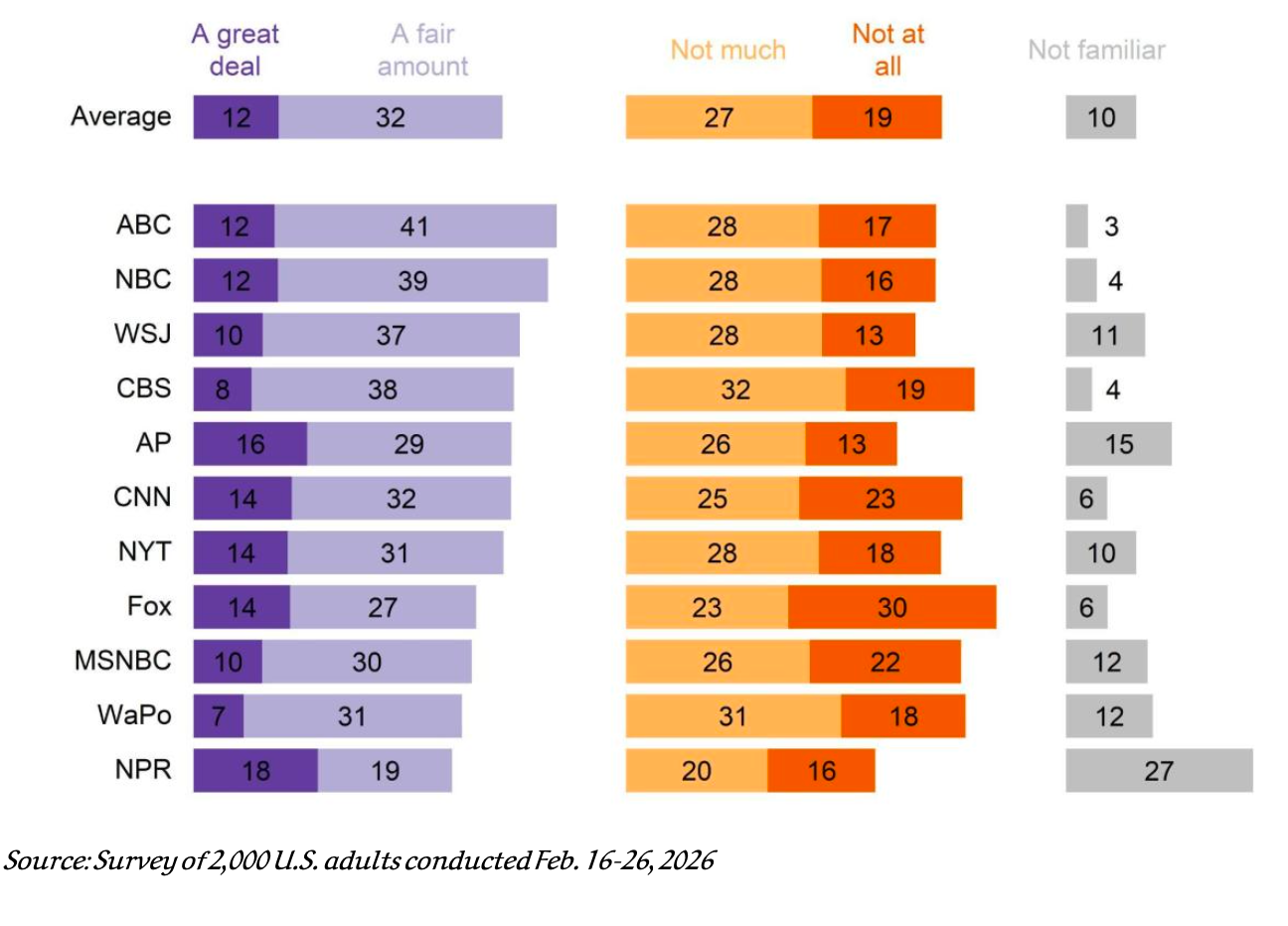
In general, Americans have mixed feelings about major news media organizations. Two leading broadcast news networks (ABC and NBC) had the highest share of the public reporting trust in their organizations overall with about half (53% and 51% respectively) of Americans reporting that they have at least a "fair amount" of trust in each. Some organizations are less trusted. For example, Fox and MSNBC (recently rebranded to MS Now) have lower levels of trust than the other television networks (41% and 40% respectively). CNN was somewhat higher at 46%. The Wall Street Journal had the highest among print newspapers at 47%.
Share who say they have ___ trust in each organization …
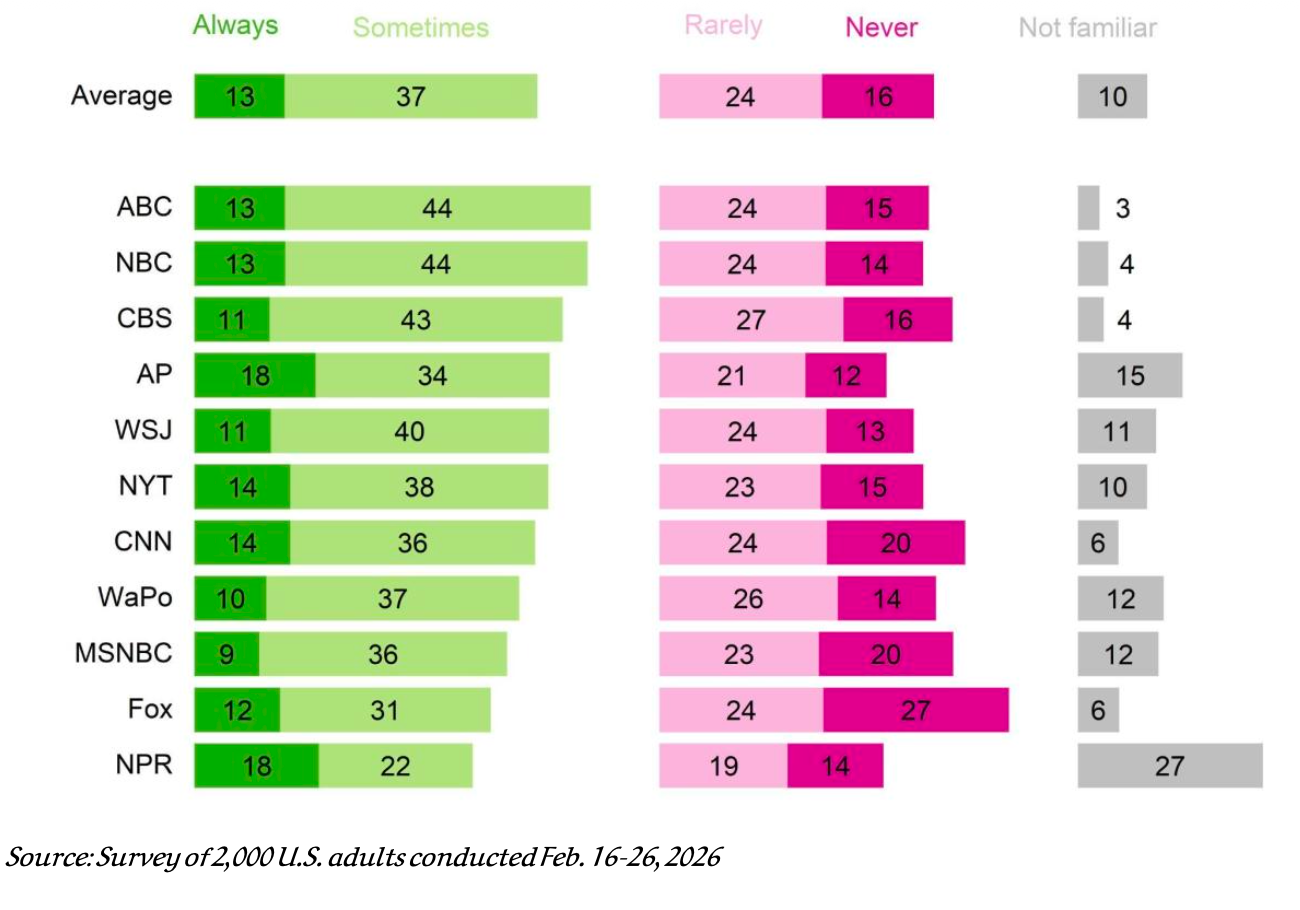
Beyond measuring general overall trust in each outlet, the survey included additional evaluations of each outlet. As with general trust in each organization, Americans' have mixed views about the extent to which media outlets make a clear distinction between their news reporting and opinion. Across the eleven outlets included in the survey, an average of only 13% of the public says that these outlets "always" make a clear distinction between fact and opinion. On the other side, 16% on average say that these news outlets "never" make this distinction clear.
Share who say each outlet ____ makes a clear distinction between news reporting and opinion.
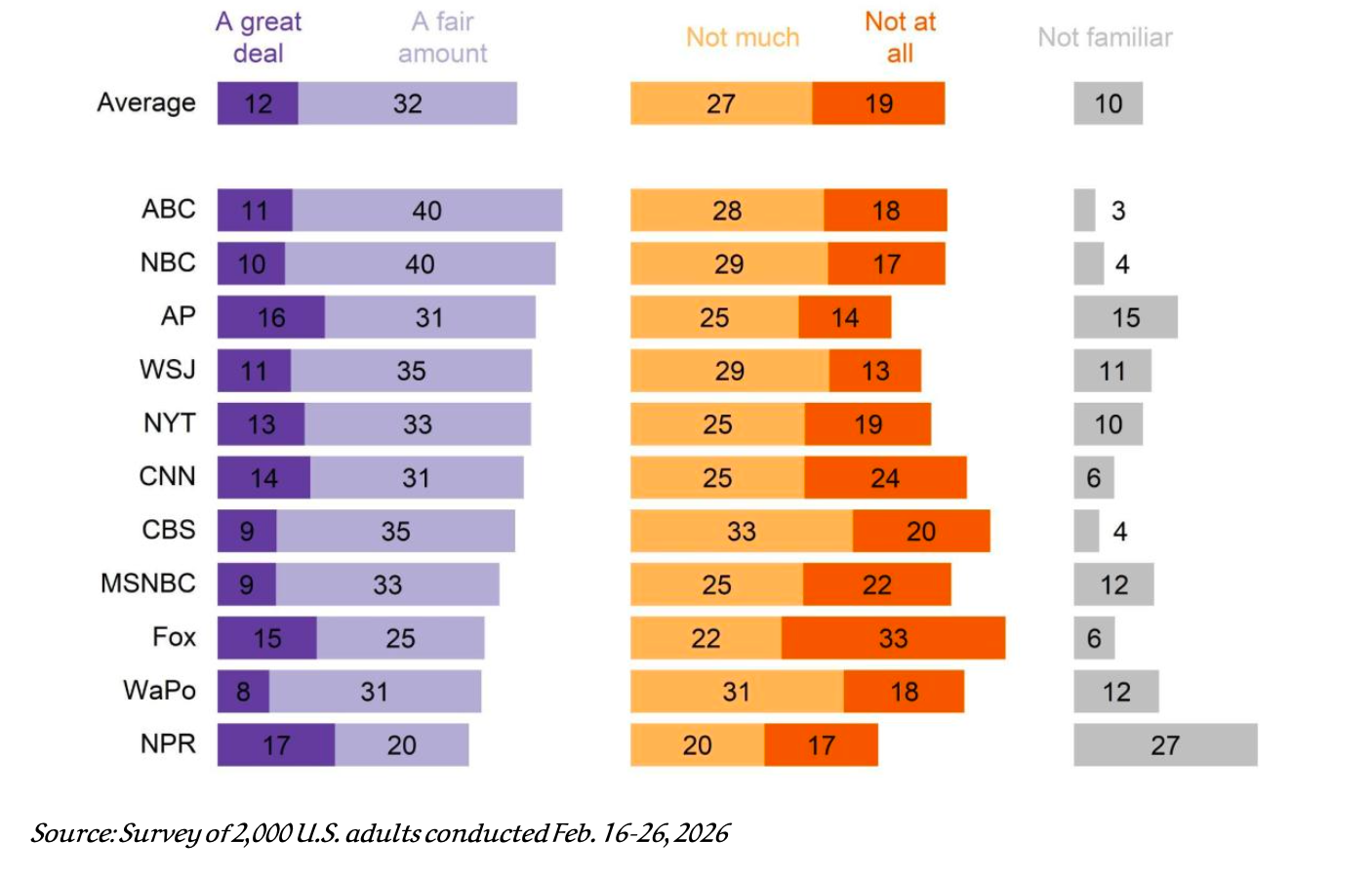
The survey also asked the extent to which Americans' trust that media outlets present facts without omitting important information that could change the meaning or context. Only 12% of Americans say that they have "a great deal of trust" in the ability of the media to present unbiased information, and nearly one-in-five (19%) overall say they have no trust at all.
Share who have ___ trust that each outlet presents facts without intentionally omitting important information that could change the meaning or context.
The relationship between different measures of trust
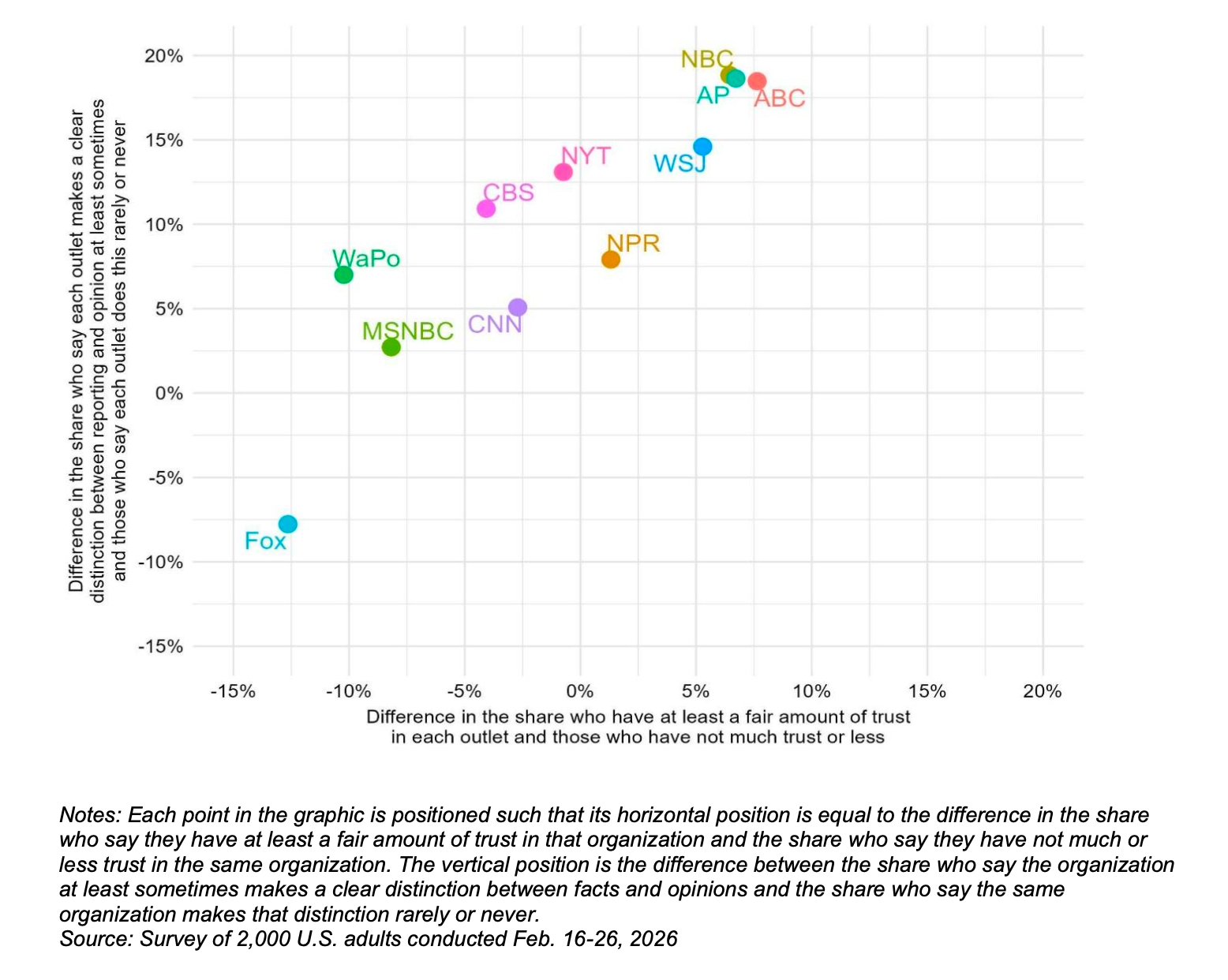
Americans' overall levels of trust in individual media outlets are closely related to other evaluations of those organizations. The plot below shows the difference between the share of Americans who say they have at least a fair amount of trust in each organization and those who trust each organization not much or not at all (on the horizontal axis) and on the vertical axis the difference in the share who say each organization makes a clear distinction between fact and opinion at least sometimes and those who say each outlet makes that distinction rarely or never.
The relationship between general trust in a news organization and evaluations of fact/opinion distinction
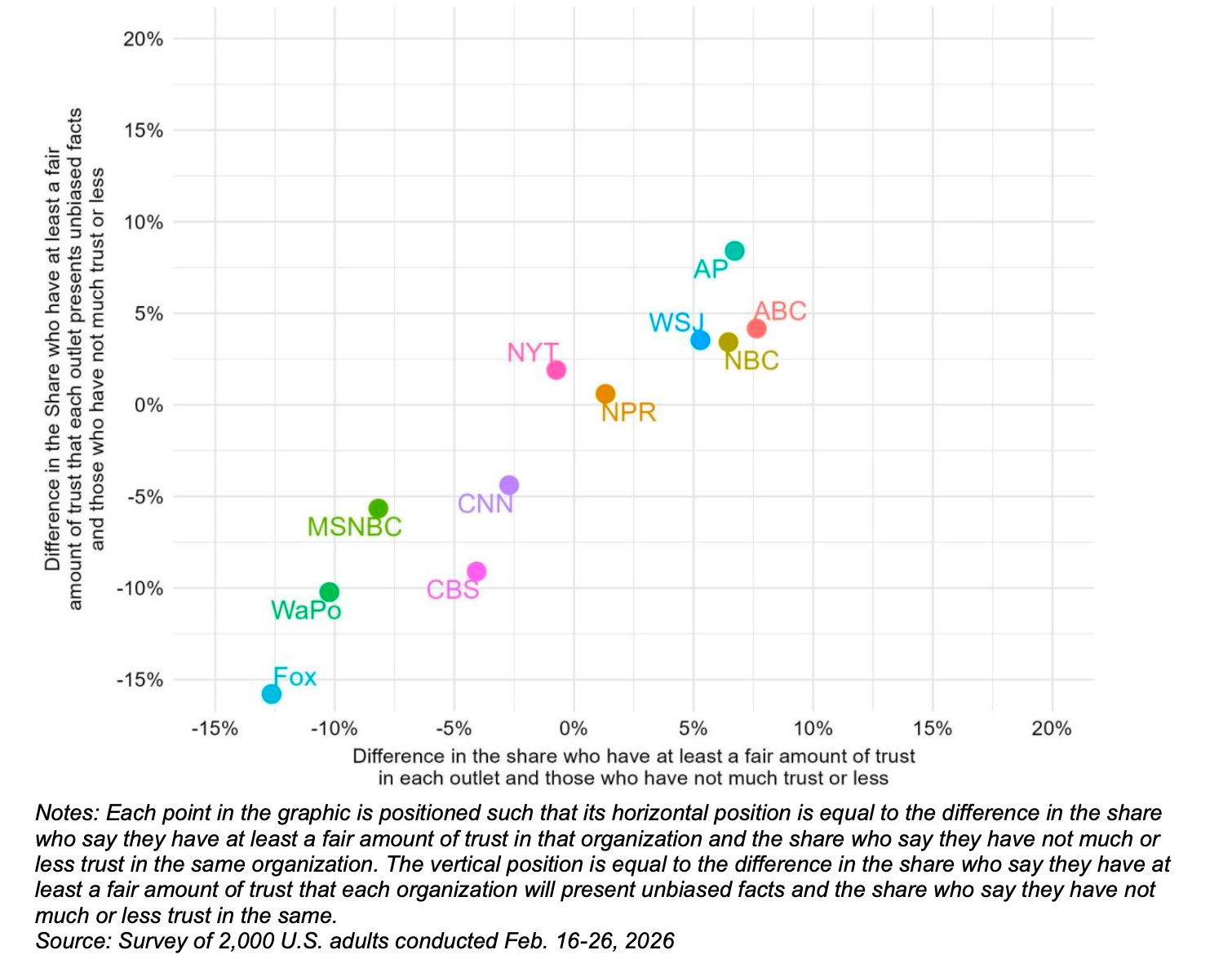
Similar to the relationship between general trust and distinctions between fact and opinion, Americans' general levels of trust in a news organization and their feelings about whether or not that organization will provide unbiased information are also closely related.
The relationship between general trust in a news organization and trust each outlet will report unbiased facts.
Methodology
For this project, YouGov interviewed 2146 respondents who were then matched down to a sample of 2000 to produce the final dataset. The respondents were matched to a sampling frame on gender, age, race, and education. The frame was constructed by stratified sampling from the full 2023 American Community Survey (ACS) 1-year sample with selection within strata by weighted sampling with replacements (using the person weights on the public use file).
The matched cases were weighted to the sampling frame using propensity scores. The matched cases and the frame were combined, and a logistic regression was estimated for inclusion in the frame. The propensity score function included age, gender, race/ethnicity, years of education, and region. The propensity scores were grouped into deciles of the estimated propensity score in the frame and post-stratified according to these deciles.
The weights were then post-stratified on 2024 presidential vote choice as well as a four-way stratification of gender, age (4-categories), race (4-categories), and education (4-categories), to produce the final weight.
CONTACT US: 501.378.3402 info@cfinr.org