COLUMN: In Austin, trust in local news was more than a talking point
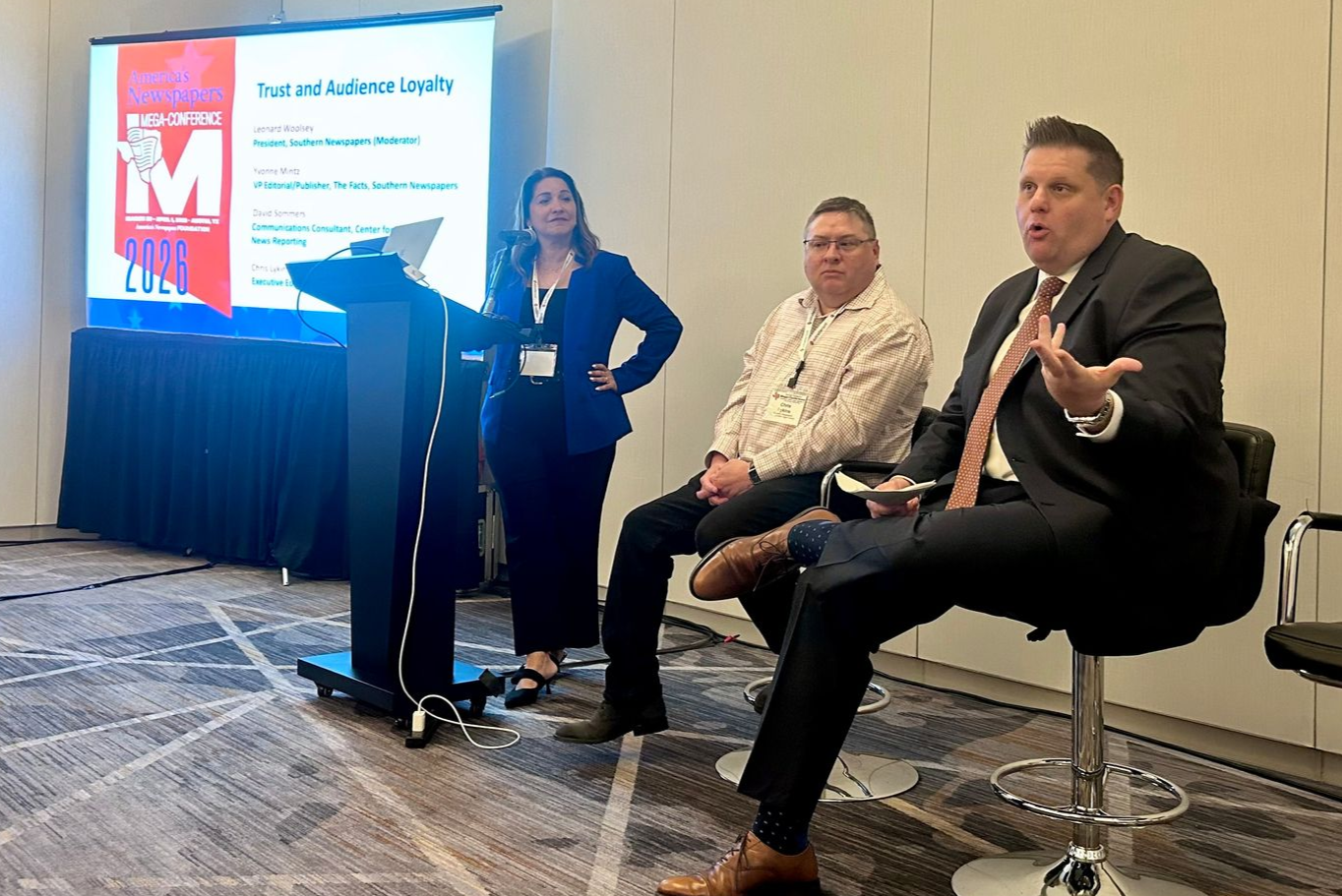
CFINR consulting communications director David A. Sommers addresses the "Trust and Audience Loyalty" panel at the America's Newspapers Mega-Conference in Austin, joined by Southern Newspapers executive editor Chris Lykins (center) and The Facts publisher Yvonne Mintz.
AUSTIN — The America's Newspapers Mega-Conference draws publishers, editors and industry leaders from across the country, and this year it landed at a moment when the conversation about trust in local journalism is front and center in national discussions. I attended the conference representing the Center for Integrity in News Reporting, participating in a panel on trust and audience loyalty. What I heard from the room confirmed something CFINR has been advocating since its founding: the industry knows the problem, and there are concrete steps news organizations can take to address it with their audiences.
The panel was introduced by Leonard Woolsey, president of Southern Newspapers; and panelists also included Yvonne Mintz, vice president of editorial and publisher of The Facts; and Chris Lykins, an editor with Southern Newspapers. Together they represented the kind of long-tenured, community-rooted news leadership that the trust conversation often centers on but rarely features directly. The discussion got substantive fast.
One of the most thoughtful exchanges came from the executive director of a state press associations, pushing back on the methodology behind long-running, well-established national media trust surveys. The argument deserves consideration. When pollsters ask the public about "the media," the attendee said, they bundle local community journalism together with cable news and national conglomerates. The resulting trust numbers misrepresent what's actually happening at the local level. That state association's on polling shows trust in local news tracking significantly higher than trust in the media in the abstract.
CFINR has cited Gallup's figures extensively — 28% trust nationally is a genuine crisis — but the' point reinforces why local news organizations have both reason for concern and reason for confidence. The problem is real. The opportunity is also real. I used the moment to note that CFINR is developing its own research to better capture that distinction, without getting into specifics. That landed with the room.
The broader conference reflected what CFINR has been saying to press associations from Kentucky to Minnesota: this industry is not in retreat on the trust question. Dean Ridings, CEO of America's Newspapers, captured it well in his post-conference reflection, writing that while AI dominated many sessions, the enduring message was that "meaningful, trusted content matters. In a fractured media environment, it is a real advantage and one of the clearest ways local newspapers stand apart."
That thoughtful sentiment aligned directly with what our panel explored. Trust is not a marketing message. It's foundational and essential, built through daily editorial decisions, impartiality and objectivity, institutional transparency and a willingness to state clearly what a newsroom stands for. That is precisely the work CFINR supports, helping news organizations develop and publish statements of core journalistic values, recognizing impartial reporting through national awards, and bringing that case directly to industry gatherings like Mega.
The room at our session was at capacity, with roughly 75 people in attendance and strong questions that pushed the conversation past its scheduled time. That appetite reflects where the industry is. Publishers and editors are not avoiding the trust question. They are looking for frameworks, examples and reinforcement.
CFINR's national awards program, which will present six prizes of $25,000 each at a gala in Washington, D.C., on May 19, is one tangible signal of that commitment. The awards recognize the kind of objective, impartial reporting that earns public confidence.
Mega was a reminder that the work CFINR is doing connects with what journalists and organizational leaders are seeing in newsrooms across the country. The conversation in Austin will continue in newsrooms nationwide, and in the ongoing effort to make trust something the industry earns back, one decision at a time.
David A. Sommers is the consulting communications director for the Center for Integrity in News Reporting.